
What is the true nature of the upcoming Simpsons chart?
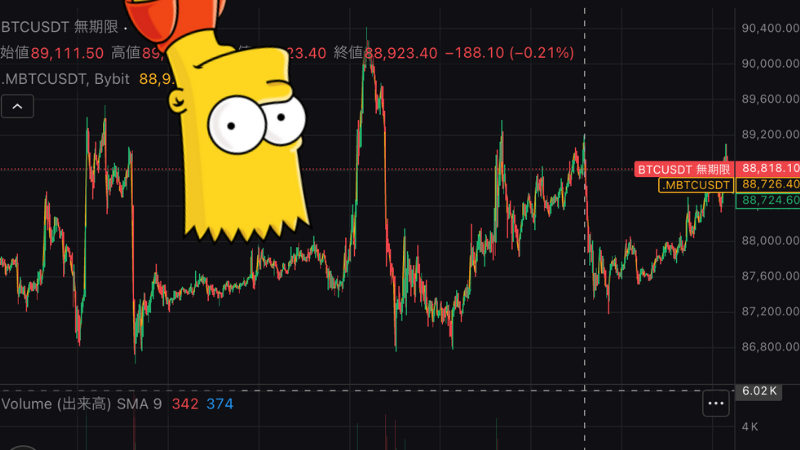
Happy New Year. This is CRYPTO INTELLIGENCE.
Recently, we have been troubled by sudden rises and falls in the market that seem unstable.
At this timing, many people may find it difficult to execute high probability trades.
The charts showing sudden rises and falls, which are hard to navigate for both long and short positions, are commonly referred to as "Simpsons charts."
1. The Nature of Simpsons Charts (Internal Structure of Price Movements)
The typical pattern consists of three stages:
- Near-vertical spikes (sharp rises or falls)
- Price "jumps" due to news, large players making moves, thin order books, or liquidation chains. At this point, many participants recognize it as "breaking out!" and chase after it.
- Unnaturally narrow range (consolidation)
- Despite the abrupt change, the trading volume dwindles, and the price stabilizes, extending sideways. Because it doesn't extend much relative to the enthusiasm of followers, psychologically, it tends to make people wait for a "pullback."
- Sudden reversal leading to "full retracement"
- It rushes to the opposite side of the range, returning to the price range before the spike. Those who jumped in following the move (high long / low short) will find themselves in trouble in a short period of time.
What’s important here is that this shape is more of a "liquidity event" than a "trend." While many trends progress gradually by updating highs and lows, Simpsons often creates biases "instantly" and resolves that same bias at the same speed. Therefore, those with a strong tendency to follow trends are more likely to get burned.
2. Why It Occurs ("Conditions That Are Likely to Happen Soon")
The common causes cited are low liquidity, market manipulation (or distortions close to it), sudden news/emotional shocks.
From a trader's perspective, the “conditions to be wary of soon” can be summarized as follows.
A) "Thin Order Book Time Frames/Symbols/Exchanges"
In environments that can shift prices quickly, it's possible to step on stops with little capital. This is why it is said that this can lead to sudden moves on shorter time frames.
B) "Positions are Concentrated on One Side"
When there’s increased open interest (OI), skewed funding rates, social media coordination, or a clear clustering of stop-loss orders at recent highs and lows, it creates a **"hunting ground"** visible in the market, making spikes → consolidation → full retracement more likely (because everyone places their stop-loss at the same place).
※ This point is often summarized in many explanations as "speculation, manipulation, and thin liquidity being involved."
C) "Temporary Price Discovery Breakdowns Around Events"
Timing involving news, indicators, options, or forced liquidations tends to extreme short-term supply and demand. As a result, only the "hair" part may form first, and if the underlying physical demand does not follow, it leads to full retracement.
In conclusion, Simpsons is a concept that looks at whether the market is structured to "kill both sides in a short time" rather than where it will go up or down.
3. Strategies for Traders (Transforming into Winning "Patterns")
Now we get to the main point: to achieve winning trades, rather than trying to predict, we need to create a design that becomes advantageous when it happens. There are three key points.
① Rule: "Don’t Chase Immediately After a Spike"
The biggest losses come from reflexively reacting to a spike by doing a "breakout trend-following" trade.
Winning traders instead make the following judgment the moment a spike occurs:
- This may be the start of a trend
- But if there's a possibility of a "Simpsons event," I’ll first look to see if a box forms
- If a box is formed, I will anticipate a "move to cut above or below the box" and refine my entry position
Thus, the first action is not an "entry" but an "observation (range assessment)."
Example of practical rules:
- If a spike occurs, wait for at least several bars (depending on the time frame) to form a range
- If volume dwindles and price widths become box-like, prohibit "following longs/shorts."
- This "non-entry rule" becomes the foundation for long-term profitability.
② Fight "Outside the Box" (Don’t Fight Inside the Box)
In horizontal sections, price can easily get whipped up both above and below. Trying to take small profits here is an action entering "the opponent's strong field."
The basic strategy can be divided into two:
Strategy A: Wait for a Box Breakout and Contrarian Trade (Targeting Full Retracement)
- Do not jump at the moment it breaks above (or below the box), but instead wait for signs of "slowing momentum / dwindling volume / weak pullbacks"
- Once signs of slowing appear, set a clear stop-loss as "withdraw if pushed back outside the box."
- Target is near the price range before the spike (starting point) = core of full retracement.
This mindset aligns with many explanations that say, "if the spike is speculative or manipulated, it can revert after a sharp decline (or rise) following a range."
Strategy B: Try Small at the Edges of the Box and Increase on Confirmation
- Test short at the upper limit of the box (long at the lower limit) with "super small lots."
- Once it starts running in the opposite direction, add to the position (not by averaging down, but by increasing in the direction with an edge).
- Set the stop-loss as a clear criterion for invalidation, such as "clearly surpassing and establishing above the upper limit of the box."
The inside of the box has low expected value, so if you trade, you should do it in the order of "test position → confirm and scale up."
③ The Key Confirmation Materials to Use are "Volume" and "Quality of Retracements"
Simpsons charts tend to look flashy, so traders may rush to identify patterns, but the confirmation axes to improve win rates are simple.
- If trading volume spikes during the spike but dies in the box, it’s a weak signal of continued supply and demand.
- Weak pullbacks (retests) against the breakout direction / inability to buy back → it becomes easier for full retracement to gain dominance.
- If it seems like we're making "new highs (or lows)" in the box but it's actually not extending, it raises suspicions of stop hunting.
Once you develop a habit of looking at this "quality of retracement," your resilience against not just Simpsons, but all types of fake breakouts will improve.
4. Fundamental Design for Creating "Winning Trades" (Reproducibility)
More important than mastering Simpsons is making what you learn here your trade OS. Those who are winning share four commonalities:
1) They Have "Conditions" Rather Than "Predictions"
Rather than correctly guessing "will it go up or down,"
- They can articulate in writing:
- When will they enter?
- When will they exit?
- When will they take profits?
- In the case of Simpsons, especially the exit conditions are crucial (because reversals are quick).
2) Loss Cuts Are "Linked to Structure"
Losers tend to set loss cuts as "what percentage against them will trigger it."
Winners set their cuts as "if it surpasses and establishes beyond the upper limit of the box", thus they cut if the structure fails. Once they can do this, their loss cuts remain consistent.
3) Lot Sizes Change Based on "Probability of the Scenario"
After a spike, noise is at its peak. They do not make large bets in low-probability scenarios.
Only when a box forms and the signs of slowing or invalidation appear do they increase their size.
In other words, the lot size is tied not to courage but to the amount of information (probability).
4) They Record and Eliminate "Their Own Losing Patterns"
Common patterns of losing in Simpsons are:
- Chasing after spikes
- Repeatedly trading inside the box
- Delayed loss cuts leading to full retracement
They usually fall into one of these categories.
5. Lastly: The Mindset to Be Wary of Recently
Simpsons charts are not definitive evidence of manipulation but hints that "distortions may be occurring." That’s why the weapons should not be flashy predictions, but rather the courage not to enter, stop-losses aligned to the structure, and discipline to fight outside the box.
If you are going to go for the "Simpsons" that may occur soon, the target should not be the "first spike" but rather the parts of the "hunting" and "full retracement" that occur after the range solidifies. The moment you adapt your design to go for this, your win rate and risk-reward ratio (R) will change significantly even in the same market.
share






Powerd by FanClub3.0
©2026 CRYPTO INTELLIGENCE